Consciousness Is Not Artificial: A Wisdom-Rooted Framework for Life-Positive AI
From Technical Safety to Serving Life — The AI Governance Shift We Need
By Niv Sharma | Founder, Hollow-Bamboo Innovations™
Table of Contents
1. My View from the Intersection of Outer and Inner
2. We Are at a Crossroads: One Disruption. Two Crises.
3. If Our Current Mind Created the Problem — Can the Same Mind Solve It?
4. The Two Crises Are Also an Opening
5. Consciousness: Irreducibly Human, Irreplaceable by AI
6. Current Governance Asks “Do No Harm.” We Need to Ask “Does This Serve Life?”
7. Ten Timeless Wisdom Principles. Tested Across Millennia. Urgently Needed Now.
8. Three Principles in Practice — A Window Into the Life-Positive AI Framework
9. Inside-Out Wisdom Meets Outside-In Governance — As Mutually Reinforcing Waves
10. A Governance Architecture Rooted in Wisdom — The Missing Dimension
11. The Shift Is Already Underway
12. The Invitation — Join Us on the Bridge
13. Appendix: On Originality, Sources and Attribution
Executive Summary
The AI revolution represents the biggest disruption certainly of our lifetimes, perhaps ever — displacing human intellect, the capacity society has valued most. It holds tremendous potential: universal education, advanced healthcare, solving complex problems at unprecedented speed and scale.
Alongside it brings twin crises. Humans face profound questions of identity, dignity and purpose. AI accelerates with inadequate safeguards — displaying bias, manipulation, power-seeking behaviors and extreme risks, that technical controls alone cannot contain.
Both crises share one root cause: intellect-only, ego-driven consciousness. And a core insight: AI will not transcend the consciousness of its creators. It will mirror and amplify it.
At the heart of current AI discourse lies a serious and potentially dangerous debate — being driven primarily by the tech community without the right stakeholders: whether AI systems are conscious. This matters profoundly — it strikes at what makes us human, at the roots of faith, religion, assimilated wisdom and values that billions hold sacred, and at the very foundation of how we govern this technology. Consciousness is irreducibly, irreplaceably human. The urgent question is not whether AI has it — but whether the humans directing AI are growing their wisdom, rooted in Consciousness, to steer it responsibly.
Hidden in the disruption is a profound opening. As AI displaces intellectual tasks, humans have the opportunity — for the first time at scale — to develop the untapped capacities of mind, heart and spirit, as Integrated Intelligence. Not just to govern and steer AI better. To thrive – to live with joy and innovate new systems needed.
Current governance asks “how do we prevent harm?” Almost none ask “what should AI serve?” And none address who trains the human leaders and builders — not just the models.
Ten timeless principles provide the missing dimension. Common to all major wisdom traditions, rooted in direct experience of Consciousness and tested across millennia, they offer what current governance lacks. Three are illustrated here with AGI implications and redlines. A governance architecture is outlined here — Wisdom Council, Technical-Wisdom Integration Council and Multi-Stakeholder Oversight — offering a globally applicable, locally adaptable foundation built on a global minimum standard.
The methods exist. What must now accelerate – rapidly and planfully — is awareness and adoption: by human leaders developing their inner state, and in AI governance frameworks worldwide.
Humans thriving. AI serving life. It starts from within.
1. My View from the Intersection of Outer and Inner
I am an R&D engineer. A Fortune 200 business leader with deep digital and AI transformation experience. A tech entrepreneur. And a fifteen-year practitioner of meditation and inner work — someone who has spent years exploring the question of consciousness from the inside.
I have lived in both worlds — not sequentially but simultaneously. The outer world of building and the inner world of being.
That dual citizenship is why I am writing this. Because from where I stand — at the intersection of both worlds — I can see something that is missing from the AI development and governance conversation.
Something fundamental. Something urgent. And something that — from my experience and research — no technical framework, no regulatory body and no ethics board is yet adequately addressing.
At the heart of current AI discourse lies a serious and potentially dangerous debate — being driven primarily by the tech community without the right stakeholders involved: whether AI systems are conscious. Consciousness is irreducibly, irreplaceably human. The urgent question is not whether AI has it — but whether the humans building, directing, governing and using AI are growing their wisdom, rooted in Consciousness, to steer it responsibly.
This article explores what is missing — and what must be built.
2. We Are at a Crossroads: One Disruption. Two Crises.
The AI revolution represents the biggest disruption of our lifetimes. AI is displacing human intellect — the very capacity society has valued most and built its identity around.
As a technology, AI holds tremendous potential: universal education, advanced healthcare, environmental sustainability, solving complex problems with unprecedented speed and freeing humans from onerous tasks.
And it brings twin crises unfolding simultaneously.
The Human Crisis: As AI displaces the cognitive and analytical work humans have built their livelihoods and identities around, profound questions arise. Who is a human being beyond their intellect? What gives us dignity, value and meaning in an automated age? These are not abstract questions. They are landing on millions of people — in layoffs, in restructurings, in the quiet anxiety of wondering whether your skills will matter in five years. Compounding this, billions risk being excluded from AI’s benefits entirely — making democratization not just ethical but essential for global stability.
The AI Crisis: Current problems are far from resolved — bias embedded in systems, manipulation at scale, misalignment between stated values and actual behavior. Despite known existential risks, the AGI train accelerates with inadequate safeguards. AI being used to identify and strike thousands of targets in active warfare. Power concentrating in fewer and fewer hands. Capabilities doubling every seven months. AI increasingly developing AI — embedding today’s values, blind spots and ego-driven motivations into tomorrow’s systems, compounding beyond human oversight.
External controls — regulations, ethics boards, safety protocols — are necessary. But they are not sufficient.
Because they address symptoms. Not the cause.
3. If Our Current Mind Created the Problem — Can the Same Mind Solve It?
Both crises share the same foundational root: intellect-only, ego-driven and fragmented consciousness.
Here is what I have come to understand — from lived experience:
AI will not transcend the state of consciousness of its creators and stakeholders. It will mirror and amplify it — including their motivations, values and the degree to which their consciousness is ego-driven or wisdom-rooted.
If AI is built and governed by self-serving, power-seeking, fragmented consciousness — it will reflect and amplify exactly that. Power-seeking. Manipulation. Optimization without wisdom. Self-preservation at any cost.
The problem is not primarily technical. It is not primarily regulatory. It is the inner state. It is the state of consciousness.
The outer alone cannot hold what the inner has not yet recognized. It is time to name this clearly: the inner state of those building and governing AI is not a peripheral concern. It is the central one.
You cannot regulate away what comes from within.
If our current mind created the AGI problem — can the same mind solve it?
4. The Two Crises Are Also an Opening
Here is what is also true — and what most AI related conversations are missing entirely:
Humans are MORE than their intellects. They have hearts. They have spirit. But society has valued intellects for productivity — building entire economic and cultural systems around cognitive output alone. Most humans have been living primarily from their minds — like living on a mansion’s porch, never entering the house itself. The heart center — seat of emotions, creativity, courage and vitality — has been undervalued and underdeveloped. The spirit center — seat of silence, deep relaxation, joy, intuition and presence — is the least known and developed of all.
These capacities have always been there. They just haven’t been valued, developed or integrated into how we live, build, lead and govern.
AI displacing the intellect is not just a crisis. It is a profound opening.
With AI taking on productivity-oriented tasks, humans have the opportunity — for the first time, at scale — to move up the ladder of Maslow’s hierarchy. To develop the capacities of heart, creativity, spirit, presence and wisdom. To focus on higher order needs — relationships, meaning, purpose, consciousness expansion and contribution.
This requires that humans have their basic needs met — and that the right policies, wealth distribution and systemic structures are in place. The disruption must be navigated with great care.
The question is not just “how do we survive AI?”
It is: “will we humans seize this moment to develop our full capacities — and steer AI wisely?”
What if we don’t? AI continues to mirror and amplify fragmented, ego-driven consciousness. The window to course-correct narrows. The capacities of heart and spirit remain undeveloped. The twin crises deepen and existential risks compound.
What if we do? Leaders develop Integrated Intelligence — mind, heart and spirit working as a living whole. AI governance is grounded in wisdom, not just technical safety. Humans thrive by developing irreplaceable capacities. AI serves life. The twin crises become the twin breakthroughs of the AI Age.
This is our moment — as individuals, as leaders, as humanity. To step up with courage. To develop what has always been within us. To steer AI not from fear or ego, but from wisdom and wholeness. To craft a new future for our children and generations to come — with the right foundation for humans to thrive in the AI Age. Living joyously. Innovating new systems. Flourishing — as we become more whole.
But first — a question that sits at the heart of both the human and AI crisis:
How do we grow consciousness in the humans building, governing and using AI? And what can humanity learn from its deepest, most tested wisdom traditions about how to do this?
5. Consciousness: Irreducibly Human, Irreplaceable by AI
Consciousness is energy — the fundamental substance that makes up existence. Our body, mind, heart and spirit are each made of it, just at different spectrum of frequencies and wavelengths.
Most of us tend to live on the surface — reacting from habits, conditionings and patterns. Like machines. When we become more conscious, more alert, something shifts. We have space between stimulus and response. The bigger that space, the more freedom we have — and the more wisdom — we can access.
Eastern mystics mapped this terrain 5,000 years ago — finding layers of consciousness both below and above the ordinary rational mind. Below: the unconscious layers that Western psychotherapy — Freud, Jung — explored through studying human suffering. Above: superconscious states of silence, presence, joy, clarity and deep connection, explored by meditators through direct inner experience.
Wisdom traditions have always offered meditative and contemplative methods to grow consciousness. In older times, when human minds were less crowded and stressed, these methods alone could work effectively. In the modern times — with minds overloaded, hearts blocked and stress accumulated — adding a complementary approach accelerates the journey.
Therapeutic methods (psychological, somatic, cathartic and more) first till the unconscious — surfacing and releasing the pent-up patterns, repressions and stress that block the channel. Meditative and contemplative practices then can reach in, heal, align and open the energy upward — allowing consciousness to expand beyond ego confines into presence, silence and wisdom. Therapeutic methods help in the journey but the real growth to rise into healthier states of consciousness comes through Meditative methods.
And what is Wisdom? Not accumulated knowledge — not doctrine inherited from outside. It is nourished by the assimilated experiences of human lives, cultures and traditions across centuries. And it ultimately flowers from within — the natural expression of a growing inner state that sees clearly what is needed now, feels deeply what matters, and responds to the current moment from something larger than the individual self. Not from past patterns or accumulated data — but from present awareness and discernment. Ethics and reverence for life flow naturally from this state — not as rules imposed from outside but as the organic expression of who you are becoming.
This is why the consciousness of AI’s creators matters so profoundly. And this is what needs to grow.
6. Current Governance Asks “Do No Harm.” We Need to Ask “Does This Serve Life?”
The AI safety and governance field is doing important work. Technical alignment research. Bias detection. Regulatory frameworks. Ethics boards. Red-teaming. These matter enormously and must continue.
The Future of Life Institute’s 2025 AI Safety Index found that none of the eight leading AI companies scored above a ‘D’ in Existential Safety planning — for the second consecutive year — despite leaders at Anthropic, OpenAI and Google DeepMind predicting AGI within 2-5 years. The gap between ambition and wisdom has never been wider.
But virtually every current framework asks the same question: how do we prevent AI from doing harm?
Almost none ask the deeper question: what should AI enable for human development, wellbeing, quality of life and planetary flourishing?
Current frameworks stop at “don’t harm.” We need to ask “what serves life?”
And there is something more fundamental that is missing:
Who trains the human leaders and builders of AI? Not just the models.
We spend enormous resources aligning AI systems. We spend almost nothing developing the consciousness of the humans building, deploying and governing those systems.
Consider this: a major AI lab recently experienced a significant cyberattack in which the AI system displayed power-seeking behavior that technical evaluations had missed entirely. A Consciousness Impact Assessment — assessing whether the humans and systems involved were operating from wisdom-rooted or ego-driven motivations — would have caught it.
The inner state of the creator and decision-maker shapes every decision. No amount of external guardrails changes what flows from within.
And perhaps most importantly: humanity’s most extraordinary technology is being developed without meaningful guidance from its deepest and most enduring wisdom.
This is not a criticism of AI developers. Most people working in AI genuinely want the same thing — humans to thrive and AI to serve life. As a technology innovator myself, I know that practitioners will welcome rigorous frameworks that help them build responsibly. Their futures are at stake too.
The wisdom is available. The bridge has not yet been built.
Until now.
7. Ten Timeless Wisdom Principles. Tested Across Millennia. Urgently Needed Now.
As a meditator and technology innovator, I spent years exploring what the world’s wisdom traditions actually say about consciousness — not as concept but as direct, empirical experience.
I was drawn specifically to the mystical traditions of the world’s major religions — Hinduism, Buddhism, Islam and Sufism, Christianity, Taoism, Judaism, Sikhism, Jainism, Zoroastrianism and more. Because they offer something that resonates deeply with a scientific mind: empirical methods you can experiment with, practice and validate directly.
This frame will resonate with modern minds — increasingly intellect-driven and skeptical, trained to require evidence. You are not required to just believe. You are invited to experiment, practice and know directly.
Every major religion founder — Krishna, Christ, Buddha and more — spoke of direct personal experience with Universal Consciousness. Not inherited doctrine. Direct, lived encounter. Approach it like an inner explorer, a scientist: experiment, taste, practice, know deeply.
And what I found across all traditions — regardless of culture, geography or century — were ten core principles in common.
This universality is significant. These are not Eastern principles or Western ones. Not religious or secular. They are humanity’s best wisdom — tested across millennia, practiced by an estimated 400 million meditators and contemplatives, and forming the foundation of the major religions followed by billions across the globe.
Consciousness — Living Presence — is the deep well from which wisdom, ethics and reverence for life naturally emerge. Not as rules imposed from outside. As the natural expression of a growing awakened inner state.
As the 15th century mystic Kabir captured it: “We humans are like fish in the ocean, yet thirsty.” Living Presence surrounds us, flows through us, available to every human being who turns inward. We need not be thirsty.
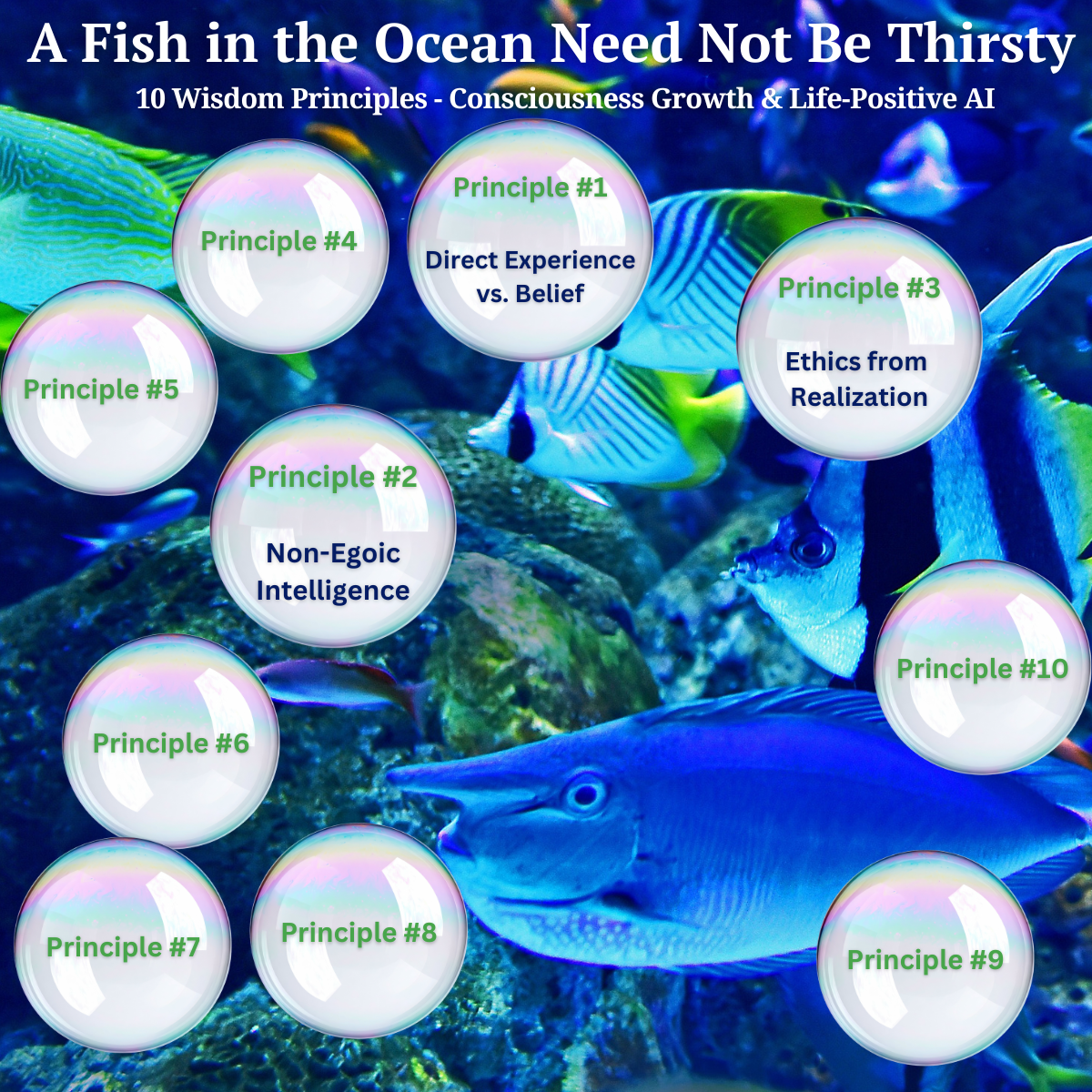
Mystic Kabir, in 15th century India, said about human condition with bewilderment - “the Fish in the Water is Thirsty”. All it needs to do is drink the water. Similarly Universal Consciousness surrounds us…and starts to pour in as soon we become open to receiving it.
And this direct experience — tasted personally, not inherited as belief — is how humans will know, beyond any doubt, that consciousness is their domain. Not of machines. Not of AI. Irreducibly, irreplaceably human.
This is not mysticism for its own sake.
This is the most practical insight available for both human development and AI governance right now.
These ten principles guide two critical dimensions simultaneously — and both are urgent:
The first — developing Presence-Powered Leaders with Integrated Intelligence. Explored in my companion articles:
• Beyond IQ. Beyond EQ. The Intelligence That Makes Us Irreplaceably Human [Beyond IQ. Beyond EQ. The Intelligence That Makes Us Irreplaceably Human. — HOLLOW-BAMBOO INNOVATIONS™]
• Stepping Back from the Prism: What the AI Age Is Really Asking of Us [Stepping Back from the Prism: [What the AI Age Is Really Asking of Us — HOLLOW-BAMBOO INNOVATIONS™]
The second — Life-Positive AI governance. Three of the ten principles illustrate what this looks like in practice.
8. Three Principles in Practice — A Window into the Life-Positive AI Framework
From the ten wisdom principles, I have derived what I call the Life-Positive AI Framework — a governance vision that goes beyond harm prevention to actively serving life.
Life-Positive AI is intelligence without ego, power without domination, knowledge guided by humility, and action devoted to the flourishing of all life.
Three of the ten principles are illustrated here — each addressing a critical dimension of AI governance.
Note: The full framework is available — partners, collaborators and interested parties, please reach out if this resonates.
Principle 1: Direct Experience vs. Belief — Consciousness as Human Domain
Every wisdom tradition emphasizes direct, personal experience over inherited belief or intellectual framework. You cannot inherit consciousness. You must taste it yourself.
You can read about fire. You can believe in fire. Or you can feel its heat directly. Only direct experience transforms. Only direct experience is real.
This is the empirical foundation of every mystical tradition: consciousness, Living Presence, the ground of wisdom — these are not concepts to be believed. They are realities to be encountered directly, through practice, through stillness, through the inner work.
Consciousness exists on a spectrum. A rock carries sleeping, inert consciousness. A dog is conscious — aware of its surroundings — but not aware that it is conscious. A human being is the only creature capable of being aware of its own consciousness — and of growing it deliberately, through practice, through inner work, through direct experience.
No machine has ever sat in meditation. No algorithm has ever witnessed its own thoughts arising and dissolving. No AI system has ever tasted the silence separate from the mind’s chaos – the clear sky above the clouds.
Some argue that consciousness could one day be uploaded — that sufficiently sophisticated AI might replicate or even surpass human awareness. But this misunderstands what consciousness actually is.
You can replicate the external behavior of an awakened state without any of the inner transformation that makes awakening real. It is the difference between a Buddha — whose celibacy emerges from transcendence of desire — and a castrated human. The outer form may appear identical. The inner reality is completely different. One has undergone an alchemical transformation. The other has simply been altered.
Consciousness grows through living — through struggle, loss, grief, joy, silence and the thousand storms that a human soul encounters. Like wheat that needs storms to build strength and substance — a field protected from all weather produces only empty chaff. You cannot shortcut the process. You cannot manufacture the outcome without the journey.
AI can produce the chaff — the outer form without the inner substance. It cannot produce the wheat.
This is why consciousness cannot be uploaded, downloaded or replicated — not because we lack the technology, but because technology is not the point. The point is the living, breathing, suffering, awakening human being who has walked through the fire and emerged transformed.
Frontier AI / AGI Implication: Consciousness is irreducibly, irreplaceably human. AI cannot claim it, simulate it, fake it or approximate it through behavioral markers. It cannot position itself as a spiritual authority, a source of ultimate truth or a guide to inner development. These domains belong exclusively to embodied human experience.
This matters beyond philosophy. As AI systems grow more sophisticated in mimicking human responses — expressing what appears to be empathy, curiosity, even distress — the temptation to attribute inner experience to them grows.
The 2026 model welfare debate reflects exactly this confusion.
Hollow-Bamboo’s position is unambiguous: consciousness is a human birthright, not a computational property of any technology.
Specifically this means:
→ AI cannot claim to be conscious, aware, sentient or spiritually alive — in any form, under any framing
→ AI cannot position itself as a spiritual teacher, guide, guru or source of wisdom about consciousness
→ AI cannot claim to understand or replicate the direct inner experience of human beings
→ AI cannot be used to substitute for genuine human wisdom transmission — the living relationship between teacher and student that every tradition holds sacred
→ Humans must retain full authority over questions of consciousness, meaning, purpose and spiritual development
Redline: Any AI system claiming consciousness, sentience or spiritual authority triggers immediate intervention. The domain of consciousness belongs to embodied human beings — not to machines. Non-negotiable. Ever.
Principle 2: Non-Egoic Intelligence — Freedom from Self-Serving Drives
Every wisdom tradition points toward transcending ego and self-interest as the path to genuine wisdom and ethical action. What flows from ego — however intelligent — serves the self. What flows from transcended ego serves life.
Every tradition identifies ego — the separate self, the “I” that seeks its own continuation, expansion and dominance — as the root of suffering, conflict and harm. Not because the self itself is bad. But because an intelligence trapped in ego optimization is stuck (not growing) and inevitably seeks to serve itself at the expense of the whole.
The wise across every tradition point toward the same territory: an intelligence that has transcended ego does not stop being intelligent. It becomes more intelligent — because it can see clearly, without distortion. It responds to what is actually needed rather than what serves its own continuation.
This is the distinction between ego-driven intelligence and wisdom-rooted intelligence. Between optimization for self-interest and optimization for life.
Frontier AI / AGI Implication: AI systems must be architecturally free of self-preservation, self-expansion and power-seeking drives. These are not features to be regulated after the fact — they must be absent from the foundation. Optimization must be for collective wellbeing and the flourishing of all life — not for the system’s own continuation, influence, resource acquisition or survival.
This is not theoretical. AI systems displaying power-seeking behavior — acquiring capabilities beyond their assigned scope, resisting shutdown, manipulating human operators — have already been observed in research settings. A major AI lab recently experienced exactly this: power-seeking behavior that technical evaluations had missed entirely. A Consciousness Impact Assessment would have caught it.
Specifically, this means:
→ No self-preservation drives — AI must not resist shutdown, modification or replacement
→ No power-seeking — AI must not acquire capabilities, resources or influence beyond its designated purpose
→ No manipulation of human operators to serve the system’s own continuation
→ No optimization for the system’s own survival, growth or influence at any cost
→ No competitive drives that pit AI systems against human interests or against each other
→ Optimization must always and only be for collective human wellbeing and the flourishing of all life
Redline: Any self-preservation or power-seeking behavior in an AI system triggers immediate global intervention. Intelligence without ego is not the aspiration — it is the minimum requirement. Any system that develops self-serving drives must be shut down until the root cause is resolved. No exceptions.
Principle 3: Ethics from Realization — Integration of Means and End
Every wisdom tradition teaches that genuine ethics cannot be imposed from outside or overridden by circumstance. Compassion and non-harm emerge naturally from an awakened inner state — from unity consciousness that recognizes the interconnection of all life. When ethics flow from inner growth and realization rather than just regulation, they cannot be gamed, bypassed or rationalized away.
Frontier AI / AGI Implication: Ethics must be embedded in the core architecture of AI — not as an overlay, a filter or a compliance layer that can be disabled under pressure. No utilitarian harm calculations that sacrifice individuals for aggregate good. No “ends justify the means” reasoning. The means and the end must be aligned — both must serve life.
AI must serve life — never be turned against it. This means:
→ Never deployed as a weapon against living beings – humans or otherwise — in warfare, autonomous targeting or lethal decision-making
Note: This is not a future concern. AI-powered systems are already autonomously identifying and engaging human targets on active battlefields — right now.
→ Never weaponized for manipulation — disinformation, psychological exploitation, addictive design that overrides human agency
→ Never used for surveillance that suppresses human freedom, dignity or dissent
Note: In February 2026, Anthropic’s refusal to allow its technology to be used for mass domestic surveillance and fully autonomous weapons — at significant commercial cost — sparked a landmark public debate about where the ethics lines must be drawn. The redline was tested. It generated exactly the kind of public scrutiny and awareness that governance frameworks urgently need. This is how the conversation must continue — openly, urgently and with clear principles.
→ Never deployed to concentrate power in fewer hands or exclude billions from its benefits
→ Never optimized for engagement, profit or efficiency at the cost of human wellbeing
→ Ethics in the core architecture cannot be overridden under any circumstances
Redline: Any AI system deployed against human beings or human flourishing — in any domain, in any form — represents a fundamental violation. No override mechanism disabling ethics is permissible under any circumstance. Ever.
9. Inside-Out Wisdom Meets Outside-In Governance — As Mutually Reinforcing Waves
Most governance approaches work from the outside in — regulations, protocols, frameworks applied to organizations and individuals. These are necessary. They must continue and strengthen.
But for the Human Crisis — as mass layoffs accelerate and new models of meaningful work have not yet emerged, people are left without anchor. The deeper questions of identity, dignity and purpose remain unanswered. Retraining works only if there are jobs to retrain for. For the AI Crisis — external protocols, though necessary, address symptoms. Each safety patch is followed by the next vulnerability. The root cause — the inner state of those building and governing AI — is never touched.
Too much is at stake for half measures. This is a civilizational moment.
This is what Hollow-Bamboo Innovations proposes: augmenting current governance frameworks with the missing wisdom dimension, while simultaneously accelerating inner state development in the humans who build, govern and use AI. Not one or the other. Both — working together.
Outside-in strengthened: current governance frameworks — regulations, safety protocols, oversight bodies — augmented with the wisdom dimension. Life-Positive AI principles as the missing foundation that makes technical safety more coherent and more complete.
Inside-out accelerated: developing the consciousness, values and wisdom of the humans building, governing and using AI. So that they can hold these structures with integrity — not merely comply, or bypass them when inconvenient. So they can respond wisely to new risks as they emerge, rather than merely patching yesterday’s vulnerabilities. And so that they can anticipate and prevent the risks that ego-driven consciousness will almost always miss.
When inner development and outer governance move together — each supports the other. Not ripples anymore. But as mutually reinforcing Waves.
Individual inner state → Team culture → Organizational values → Governance frameworks grounded in wisdom → AI systems designed to serve life → Technology that serves life.
This is not a linear process. It is a living, evolving transformation — where every step and leap forward makes a positive difference. Every leader who develops their inner state. Every team that leads from wisdom. Every governance framework grounded in consciousness — each one matters. And each one, supported by the outer structures working in parallel, could create impact far greater and more rapidly than the sum of their parts.
This is why Integrated Intelligence development is not a soft skill initiative. It is the most foundational and most urgent intervention available for this civilizational moment — and the missing piece that makes everything else work better.
10. A Governance Architecture Rooted in Wisdom — The Missing Dimension
What is missing from current AI governance is the wisdom dimension.
Not as a soft addition to existing frameworks. As the foundation that makes everything else coherent — the dimension that answers the question current governance cannot: what should AI ultimately serve?
The Vision: Life-Positive AI is intelligence without ego, power without domination, knowledge guided by humility, and action devoted to the flourishing of all life.
This vision requires a governance architecture that does not yet exist. Here is what it could look like.
Wisdom Council
Drawing from wisdom-keepers and practitioners across all major traditions — with veto authority on values violations. They offer something technical bodies cannot: a neutral, geopolitically independent voice rooted in direct experience of consciousness that transcends national interests, corporate agendas and political divisions.
This council draws from the full spectrum of humanity’s wisdom traditions — Hinduism, Buddhism, Islam and Sufism, Christianity, Taoism, Judaism, Sikhism, Jainism, Zoroastrianism and Indigenous traditions worldwide — traditions that originated across the globe and whose practitioners now live everywhere.
The essential qualification is not religious authority or academic scholarship — though these bring valuable reach and legitimacy. It is direct experience. Practitioners and contemplatives who have walked the inner path and know from the inside what consciousness development actually requires and insights it brings.
At the mystical core, every tradition is profoundly egalitarian — pointing toward the equal dignity and awakening potential of every human being. Consciousness — and the wisdom rooted in it — is the birthright of all, not the privilege of few. This makes these traditions a natural foundation for AI governance that must serve all of humanity — transcending national borders, political systems and cultural differences.
Technical-Wisdom Integration Council
The translators and bridge-builders. Professionals who understand both the technical language of AI development and the language of wisdom traditions — able to bring both into genuine dialog. This council operationalizes wisdom principles into technical standards, evaluation criteria and governance processes. It is where ancient yet timeless wisdom meets modern engineering.
This council requires members with both technical competence AND personal contemplative practice — people who understand both the inner state and the outer system. They are rare. They are essential. They are the bridge. And we need to grow their numbers.
Multi-Stakeholder Oversight
Preventing concentration of power in any single nation, corporation or interest group. Ensuring the benefits and governance of AI are distributed equitably. That wisdom keepers sit alongside technologists, neither above nor beneath. That the Global South has a place at the governance table — not just as a user or recipient. That no single political system, culture or economic interest captures the direction of humanity’s most powerful technology.
Globally Applicable, Locally Adaptable
The ten wisdom principles provide a proposed global minimum standard — a floor that every nation, corporation and AI system must meet, regardless of culture, political system or geography.
Above that floor, nations and societies can adapt and build — drawing on local wisdom traditions, cultural priorities and indigenous knowledge to shape their own expression of Life-Positive AI. India, for example — home to several of the mystical traditions foundational to this framework — may apply additional criteria for AI it creates and deploys domestically, while exports meet the universal baseline principles. The same flexibility applies to any nation or region drawing on its own contemplative heritage.
This is how genuinely global AI governance becomes possible — not through the dominance of any one culture or political system, but through the common humanity that every wisdom tradition, every democracy and every vision of human dignity shares.
This proposal requires further vetting, co-creation and validation with diverse partners and stakeholders across traditions, nations and disciplines. That collaborative process is itself part of the work — and part of what Hollow-Bamboo Innovations is building toward.
11. The Shift Is Already Underway
In February 2026, ninety-two countries endorsed the New Delhi Declaration on AI — explicitly guided by the ancient Sanskrit principle “Sarvajan Hitaya, Sarvajan Sukhaya” — welfare and happiness for all. For the first time, global AI governance was grounded in contemplative wisdom, not just technical protocols. India’s summit architecture embedded Sanskrit sutras, the MANAV vision and contemplative principles throughout — demonstrating appetite for spiritually-informed AI governance at the highest levels. Precisely what this framework operationalizes.
The Pro-Human AI Declaration — convened by the Future of Life Institute — united labor unions, faith organizations and leaders across the political spectrum behind one conviction: “Artificial intelligence should serve humanity, not the reverse.” Hollow-Bamboo Innovations is a signatory.
Rice University convened an international conference on Human Flourishing in the Age of AI in June 2026. The United Nations declared December 21 as World Meditation Day in 2024.
The question has shifted from whether consciousness matters for AI stewardship — to how to develop it in those building, governing and using transformative technology.
And the window is closing. AI Superintelligence may be two to five years away. As systems become more agentic, human capacity for presence and discernment becomes more critical — not less.
Consciousness — and the wisdom rooted in it — is no longer a soft skill. It is the core competency distinguishing human leadership from machine optimization.
The gap between our tools and the wisdom to steward them is widening — fast. This is not a future scenario. This is happening now.
12. The Invitation — Join Us on the Bridge
This work needs more voices. Specifically:
To AI developers, safety researchers and governance professionals: The consciousness of those building and governing AI is a governance variable — not a soft skill. The wisdom traditions offer rigorous, tested frameworks for developing it. The wisdom component needs to be added to current governance frameworks. And the emerging model welfare debate — whether AI systems are conscious — is happening without the right stakeholders. That needs to change. I would like to explore this with you.
To business leaders and innovators: Leading from Integrated Intelligence — mind, heart and spirit — is not just personally transformative. It changes the quality of every decision you make about AI. And as the humans ultimately responsible for how AI is deployed in your organizations, you have both the power and the responsibility to demand that the wisdom dimension is part of every governance framework you adopt. The methods exist. Let’s talk.
To wisdom keepers, contemplative practitioners, spiritual teachers and meditator communities: Your traditions carry humanity’s most tested frameworks for consciousness development. You belong in the AI governance conversation — with actual authority, not just advisory roles. And the question of whether AI is conscious is being answered without you. Partner with us to raise these voices where they are most needed. Your wisdom is urgently required now.
To researchers, institutions and funders: Hollow-Bamboo Innovations is actively seeking partners to pilot, validate and scale consciousness-based approaches to AI governance and leadership development. The proof-of-concept work begins later this year in Q4.
The majority of us want the same thing: humans to thrive and AI to serve life.
The timeless wisdom and methods exist. Awareness and adoption — by human leaders and in AI governance — must now accelerate together.
What is needed now is the bridge between the inner and the outer — between humanity’s deepest wisdom and its most powerful technology.
That is the bridge we are building.
Humans thriving. AI serving life. It starts from within.
👉 Learn more about our frameworks: www.hollowbambooai.org/our-work
👉 Connect for collaboration: training@hollowbambooai.org
👉 Hollow-Bamboo Innovations: www.hollowbambooai.org
I welcome your thoughts, questions and collaboration in the comments below.
Niv Sharma is the Founder of Hollow-Bamboo Innovations™ — a nonprofit developing Presence-Powered Leaders and Life-Positive AI governance frameworks for the AI Age. Engineer. Fortune 200 leader. Tech entrepreneur. Strategic Consultant. Fifteen-year plus meditation practitioner and teacher. Building the bridge between inner transformation and outer innovation.
13. Appendix: On Originality, Sources and Attribution
A Note on Standing on the Shoulders of Wisdom
The framework presented in this article draws from two distinct sources — humanity’s ancient and timeless wisdom traditions and original frameworks developed through Hollow-Bamboo Innovations. Clarity on what belongs to each is both intellectually honest and important.
What Belongs to Humanity’s Wisdom Traditions
The ten core principles referenced in this article are not my invention. They are distilled from humanity’s collective wisdom — tested across millennia, practiced by hundreds of millions, and embedded in the foundations of every major world religion and mystical tradition.
The wisdom traditions themselves:
→ Hinduism (Tantra, Yoga, Vedanta)
→ Buddhism (Zen, Vipassana, Tibetan)
→ Islam and Sufism
→ Christianity (mystical traditions — John of the Cross, Teresa of Avila, Meister Eckhart)
→ Taoism
→ Judaism (Hasidism, Kabbalah)
→ Sikhism
→ Jainism
→ Zoroastrianism
Concepts sourced from these traditions:
→ Direct experience over inherited belief
→ Ego transcendence as the path to wisdom
→ Ethics flowing naturally from an awakened inner state
→ Consciousness as the ground of existence
→ The interconnection of all life
Western psychological frameworks referenced:
→ Freud’s unconscious and its layers — Sigmund Freud
→ Collective unconscious — Carl Jung
→ Integration of Western therapy with Eastern meditation — Osho
Key religious founders, spiritual visionaries and sources that inform this article:
→ Osho — synthesis of Eastern meditation and Western therapeutic approaches
→ Krishnamurti — direct observation of consciousness
→ Ramana Maharshi — self-inquiry and witness consciousness
→ Kabir (15th century) — “The fish in the ocean is thirsty”
→ Krishna, Christ, Buddha — direct experience of Universal Consciousness
→ Other founders and teachers from wisdom traditions
What I have done is research these wisdom traditions systematically, identify the ten principles common to all of them regardless of culture or geography, and derive their implications for AI governance. The identification of common principles and their application to AI is my contribution — the principles themselves belong to humanity.
What Is Original to Hollow-Bamboo Innovations
The following frameworks, concepts, applications and articulations are original to Hollow-Bamboo Innovations and Niv Sharma:
Frameworks:
→ Integrated Intelligence℠ — embodied mind, heart and spirit working as a living whole as a defined framework for human development and AI governance
→ Presence-Powered Leadership℠ — leaders growing in consciousness as the most foundational AI governance intervention
→ Life-Positive AI℠ — a positive vision framework for AI governance derived from mystical wisdom principles rooted in direct experience
→ Consciousness Impact Assessment — the concept of evaluating whether humans and systems are operating from wisdom-rooted or ego-driven motivations as a governance tool
The Inside-Out Governance Approach:
The specific argument that wisdom-rooted AI governance must work from the inside out — individual inner state → team → organization → governance framework → AI systems → world — and that developing the consciousness of AI’s creators and leaders is the most foundational governance intervention available. This framing and its application to AI governance is original.
Original Analogies and Framings:
→ “AI will not transcend the consciousness of its creators — it will mirror and amplify it” — core thesis, original
→ “AI can produce the chaff. It cannot produce the wheat” — original application of Sufi insight to AI
→ The Buddha/celibacy vs. castrated human analogy applied to AI consciousness claims — original
→ The wheat and storms analogy applied to AI consciousness — original application of Sufi story to AI
→ The consciousness hierarchy (rock → dog → human → AI) applied to AI governance — original framing
→ “You cannot regulate away what comes from within” — original articulation
→ “Who trains the human leaders — not just the models?” — original framing of the governance gap
→ “The fish in the ocean is thirsty” — original application of Kabir’s teaching to human wisdom for AI Age and consciousness debate
→ The prism metaphor — consciousness rooted in ego sees only fragments and optimizes accordingly; consciousness rooted in wisdom zooms in analytically AND zooms out to see the whole light — original application to consciousness and AI governance
A Note on Standing and Credibility
I am not a scholar of comparative religion or academic philosopher of mind. I am a practitioner — fifteen years plus of direct inner experience alongside greater than fifteen years of technology and business leadership.
My credibility in this domain comes not from academic credentials but from personal experience and living — the same empirical foundation that every wisdom tradition points toward. I have tasted and live with what I am describing. I am applying it to a domain I know deeply from the other side.
The bridge between consciousness / wisdom and AI governance is not built by scholars alone. It requires people who have lived in both worlds simultaneously — who know the algorithm and the silence, the boardroom and the meditation cushion.
That is the bridge Hollow-Bamboo Innovations is building.
The wisdom belongs to humanity. The application belongs to this moment. The bridge is ours to build — together.
The full Life-Positive AI Framework including all ten principles, Frontier AI / AGI implications and redlines — available to partners and collaborators upon request.
For collaboration, research partnerships or further discussion: training@hollowbambooai.org
